For all those who attended the workshop I presented today on Creating a Coat of Arms, here are the links to the various files I used in the presentation. I hope you find them useful!
Differentiation.
It's the buzz word among many professional development workshops I've been to in the past number of years.
You know how it is... You've got a class of 20+ students of all different likes/dislikes, abilities, interests (and in my case grades!). You work your hardest to meet the needs of everyone in the class: those happy with the middle of the road, those who ask questions, those who prefer to wallflower it, those who are on their own individualized plan, and so on.
At many in-services, what frequently comes up is the fact that it's those who are more gifted that are often not challenged enough by everyday activities in the classroom.
I find that in my teaching practice the easiest area to differentiate instruction and activities is in the math class. It's in the math activities that I can really see all of the students in my class flourish at their level and sometimes even jump beyond (yay!). In fact, I've seen HUGE improvements in many of my students' math abilities and interests as the school year has progressed.
Except for one...
I have one student in my class who is bright as a button. She's smart. In many ways she sees things and looks at things and questions things on a level that is far beyond her classmates. It's just innately there.
So, when we were finishing up our little mini-review lesson on factoring and greatest common factors I wanted to challenge her. (She's the student who would stay in during lunch to do many, many long division problems by hand, using a chair to reach the top of the whiteboard just to see if she could find patterns in remainders that would connect with repeating decimals!)
In challenging her, I also wanted everyone to very successfully complete this "quizzie-poo", as I call them.
Well, it worked.
Instead of giving everyone the same numbers to work with, I gave each student a different pair of dice to work with. They had to roll 2 numbers to find the factors and GCF of the 2 numbers. Some students had regular 6 sided dice. Some had 10 sided dice. Some had dice with multiples of 10. Some didn't. It was a resounding success!
Everyone worked so diligently, so well at this task. They really enjoyed it. They were successful.
And my student there... she worked into lunch... loving the challenge, exclaiming,
"It was the hardest thing she had worked on this year!"
She was excited, happy, and proud!
I'll remember this one as a great differentiated lesson!
I've been challenging my students lately; they're so accustomed to cookie-cutter lessons and silver platters handing them things. And, yes, I believe I'm partly to blame because I get caught up in my quest to "prepare them for junior high" (a whole other blog post). So, when I simply gave them baskets of electrical equipment on their desks, the groups were challenged, mad, and amazed that I wasn't going to tell them how to assemble a working circuit.
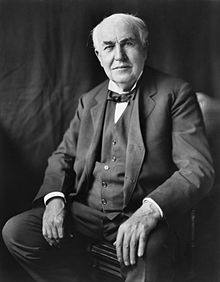
Instead I showed them pictures of these guys:
and I asked them what they did years and years ago? Did they run to google? Did they ask their teachers to guide them step by step in their exploration of sound or light?
"No, they experimented."
"They tried things, and when it didn't work, they tried again."
"They revised their plan."
"They asked questions."
"They gave it a shot."
And the light bulbs went off. (YAY!)
I assured them that experimenting, trial and error, trying something and revising it, reflecting on things, etc. was all part of much daily work: inventors, designers, automotive workers, mechanics, even teaching and parenting. And, even though the lesson was about their learning about circuits and electricity, the trial and error part of teaching was resonating with me...
Enter the Write/Right conversation/inner battle I have from this morning...
Yesterday we read a blog post by @suzemuse which talked about passion and how she was inspired by @Cmdr_Hadfield's passion from his posting from the ISS. We tweeted with Susan. We had wonderful discussions. We talked at length about passion and being passionate.
This morning, we talked a bit more about passion. Students looked up the meaning in the dictionary to make sure they were really 'getting it'. There was a lot of discussion about NHL hockey teams and the playoffs. We pondered the question, "Can you really be passionate about something when you're young or does passion need to develop over time?"
We were going places... deep places.........................................or so I thought.
I asked the students to write on a piece of paper their feelings, thoughts, ideas about passion. We had a word splash on the board. We had our questions on the board. And I was met with an astounding
These kids were SCARED to write. Intimidated. Embarrassed. And I was left thinking,
"HOW DID THIS HAPPEN?!?!?"
I felt so defeated. So let down. I asked my colleagues about this; one assured me that that's "always been the way with that group". Huh? Unacceptable. Someone has to light their creative fire somewhere... and it's MAY!... and I feel that someone is me... and I feel like I've failed. BADLY.
But now as I sit back, I can't help but wonder if it wasn't just a bad morning, a bad day for some of these kids. They've written well in the past. However, I still recall being faced with the I-Can'ts earlier in the year, too.
I've gone wrong. And like any good inventor, I'm reflecting on what I can do to revise and refine things to make them work better. And like any good thinker... I'm also open to suggestions...
Here I am on another stormy Tuesday... or what was a stormy Tuesday earlier this morning. I'm sure that the right decision was made to cancel school this morning so that students' safety on buses, walking to school, etc could be assured.
I wouldn't want to make that call. I wouldn't want to be the one making the decision that is always going to make some people irate.
Storm days are a source of much debate for the general public.
"Why should teachers get the day off?"
Unlike many people who are stormed in or travelling on wintry roads, it's a real matter of importance for a teacher to be able to get to work better than on time. Someone has to be there to great the kids getting off the buses or out of their parents' cars. That bell rings to start my school day at 8:50 promptly... with students sitting in their desks... whether I've managed to make the trek or not. I can't simply delay my work for an hour if I need to shovel out. I can't let my "office" simply handle itself. It's a different kettle of fish all together.
But do teachers really get the day off? I'll be working all day at my report cards; something for which I'm grateful, because if today wasn't a storm day, I'd be doing these report cards every evening and weekend from now until they're due at my principal's office. Last time I checked my pay cheque, I didn't get the overtime pay for that last term... hhhmmmmmmm....
Below is a response I wrote to another teacher's blogpost re: storm days. My response deals with school being cancelled part way through the day, instead of first thing in the morning.
I don't think these storm days are "free" days in any shape or form...
Pinterest has become my on-line collection of teaching goodies. Almost everything I've found on Pinterest and tried in my classroom has worked with resounding success! However, navigating through Pinterest can be daunting and overwhelming. Well-organized boards help the process, but I thought I'd share some of my favourite pinners here for even easier exploration.
While many of my "finer" teaching ideas come on a whim during those precious "teachable moments" in the day-to-day classroom, sometimes I just need something to ignite my approach with a curriculum topic.
This is where pinterest comes into play. My darling husband thinks I'm simply wasting time pinning things on pinterest, but one look at the many ideas on my school :: boards shows the wealth of ideas and time savers, actually, that can be found on this site for teachers. It's a fabulous way to organize all those great teaching ideas that one time simply swam in my thoughts at 3am.
Thank you to all those educators who take the time to share their classrooms and ideas with the world!
If you've found something that's interested you on my pinterest boards via this blog post, feel free to leave me a comment below.
In my class, I’ve introduced my students to the whole world
via Twitter. We started by sending out random tweets about what topic we were
exploring that day. One eerily calm day in January, 2011, we tracked a snow
storm that was heading our way and found ourselves and our tweets mentioned the next
morning on CBC Newsworld ,
as they followed our snow storm tracking tweets. We like to think we put Iona
on the map.
This year, as last, we tweeted out thoughts with students
and teacher across the globe as part of the Global Read Aloud Project.
We also had fun on February 29th tweeting with twins as part of our “Math
Word Problem of the Day” to figure out their ages because they were born in a
leap year. However, the most rewarding experience thus far, is our tweeting as
we explored the Holocaust.
Each year, to explore the Holocaust I choose a book to read
aloud to the class. We read it. We discuss it. We share some tears. We beg for another chapter. This year our book
was ‘Hana’s Suitcase’ by Karen Levine. As we started the book, we sent out a
simple tweet: “We are about to start our read aloud of the book ‘Hana’s
Suitcase’ #HanasSuitcase” From there, the excitement built. Page after much
anticipated page we learned of Hana and George Brady, two young siblings during
the time of the Holocaust. We also learned about a young lady from Japan,
Fumiko, who started a Holocaust museum to teach the children of Japan about the
Holocaust and about a little girl’s suitcase – Hana’s Suitcase. The story was
so interesting.
You can only imagine the excitement
when we received a tweeted reply:
:@inmyclassroomGreat! Would love to hear their thoughts! Fumiko
The squeals and questions of
disbelief rang through the classroom – Fumiko, whom we were reading about in
the book was tweeting with us! All the way from Japan, Fumiko was chatting /
tweeting with us! The conversation continued as we leafed through the pages. We
asked Fumiko questions; we shared our thoughts. In one tweet we shared journal
entries that we featured on the class blog.
Then, an hour later, we received a tweet from @LaraHanaBrady. We couldn’t
believe our eyes. Who was this tweeter, this online entity with the same name
as the little girl in our book? Her niece. George Brady’s daughter.
All of a sudden, learning about
such a difficult time in history, something so distant, became real. My little class in Iona had a
personal connection to the story we were reading. Suddenly they weren’t just
words on a page or a story read by the teacher – they were the real words,
thoughts and emotions felt by George, Lara, Fumiko and Hana. As we finish our
follow up activities with this book, we are sharing them with Lara, George,
Fumiko and the world. It’s now become a
story of the past and the present. A story of here and there. And in many ways,
not a story of “them”, but a story of us.
@ruralteacher @inmyclassroom What does that mean?
It means that I’m a teacher in a rural area.
To some that means too long of a commute, too few opportunities, but to me it’s
in many ways a blessing.
In today’s world, there does not need to be a geographical
divide; it’s a world of fast tracking, fast moving, instantaneous technology. I
have chosen to embrace the opportunities that technology can provide students,
and perhaps the most instantaneous, the most rewarding thus far has been
through Twitter.